
Azure OpenAI Solution Design and Deployment
Design and deploy enterprise-grade solutions powered by Azure OpenAI, tailored to your business processes and integrated securely into your existing technology landscape.
Who we are, what we believe in, and the team driving Synapx forward.
The industries we serve and the outcomes we deliver across each sector.
Our Partner Programme: one agreement, with subcontracting and referral routes to grow together.
How Microsoft funding programmes can support your project, subject to Microsoft's eligibility and approval.
Join a team of Microsoft specialists building the future of data and AI.
Upcoming webinars, Microsoft In a Day workshops and executive briefings from our team.
Pro-Code Agents on Microsoft Foundry, Azure OpenAI & Claude
When a workflow needs deep multi-step reasoning, custom orchestration or product-grade control, low-code runs out. We design, build and run AI agents and multi-agent systems in code, with evaluation, tracing and human approval built in from the first commit.
The Engineering End of Enterprise AI
An AI agent is a system that plans work, calls tools, checks its own output and hands off to people or to other agents, with humans approving the steps that matter. A multi-agent system puts several of them to work on one problem: a planner decomposing the job, workers executing in parallel, a reviewer challenging the output before anything reaches a customer. This is the engineering end of our AI practice, and it is where the workflows too heavy for a chatbot builder get solved.
Grounding does the heavy lifting. Most of what we build sits on private generative AI foundations: knowledge assistants that answer from your documents with citations, retrieval pipelines over governed data, document intelligence that turns unstructured contracts, claims and correspondence into structured decisions, and Azure OpenAI integrations that put all of it inside your security boundary rather than on someone else's infrastructure.
On orchestration we are deliberately framework-agnostic. We build with Microsoft Foundry Agent Service where a managed, Azure-native runtime with enterprise governance is the right call, with LangChain and LangGraph where a workflow needs full control of the reasoning graph, and with CrewAI where role-based agent crews get a team productive fastest. The framework is a consequence of the workload, never the starting point, and the comparison below is the conversation we have with every client.
Models follow the same logic. As a Solutions Partner for Microsoft Cloud with the AI Apps on Microsoft Azure specialisation, we run Azure OpenAI models inside Microsoft Foundry for estates that need Azure-native controls, with the platform side covered in depth by our Microsoft Foundry practice, and we build on Claude as a Claude Certified Services Partner where complex, multi-step reasoning and tool use earn their keep. Every system ships with evaluation harnesses, tracing and human-in-the-loop approval gates, because an agent nobody can audit is an incident report waiting to be written.
Two near neighbours worth separating. If a well-bounded agent over Microsoft data would do the job, you want Copilot Studio, covered by our Microsoft Copilot consultancy, and you will be live in weeks. If you want agents building your software rather than running your workflows, that is agentic development. We deliver all three, so the recommendation you get is the right route, not the one we happen to sell.
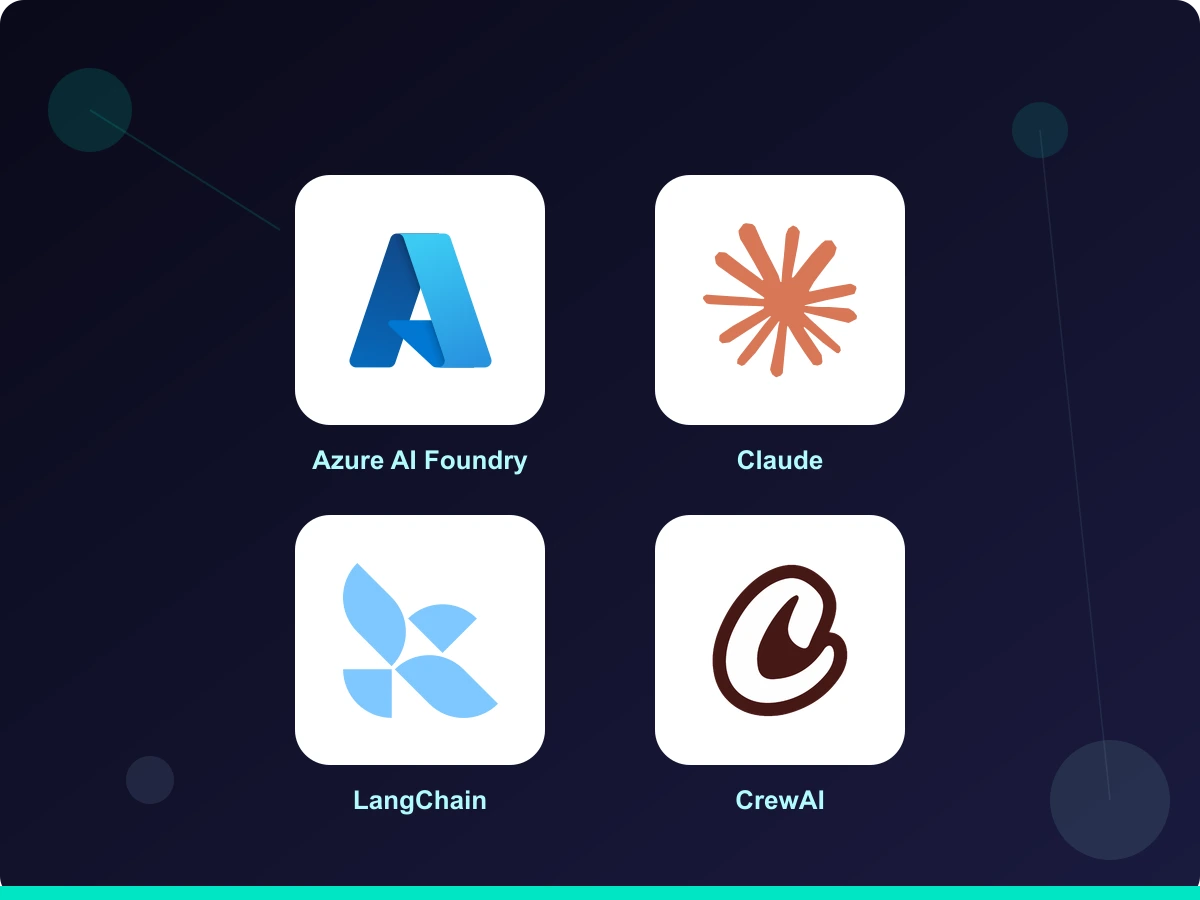
Built on Microsoft Foundry, Azure OpenAI and Claude
Design and deploy enterprise-grade solutions powered by Azure OpenAI, tailored to your business processes and integrated securely into your existing technology landscape.
Build private, secure generative AI architectures and knowledge assistants that answer from your own data with citations, keeping sensitive content inside your boundary.
Design and build multi-agent systems with planner, worker and reviewer patterns, using Microsoft Foundry Agent Service, LangChain, LangGraph or CrewAI as the workload demands.
Turn contracts, claims, invoices and correspondence into structured, decision-ready data with agents that read, extract, validate and route, including Xtract, our AI-powered data extraction product, for document-heavy workloads.
Every agent ships with an evaluation harness, golden datasets, regression gates and tracing, so behaviour is measured before launch and monitored after it.
Stand up the platform your agents run on: Microsoft Foundry hubs and projects, RBAC, private endpoints, model routing and cost management, covered in depth by our Microsoft Foundry practice.
Microsoft Certifications
Microsoft MVPs
Solutions Partner Designations
Industries with multi-agent programmes in flight today
Agents shipped with human approval gates on consequential actions
Agents in production without evaluation, tracing and an owner
Orchestration frameworks we build on: Microsoft Foundry Agent Service, LangChain, CrewAI
Model stacks in production: Azure OpenAI and Claude
Agents read claims packs, extract and validate the facts, flag inconsistencies and route decisions to humans, cutting cycle times in document-heavy insurance and finance workflows.
Workflows that span CRM, ERP and line-of-business systems, where an agent plans the steps, calls each system and asks a human before anything consequential happens.
Assistants that answer from policies, contracts and institutional knowledge with citations, deployed privately so sensitive content never leaves your boundary.
Agentic capability embedded in your own software and services, engineered with the evaluation and cost controls a customer-facing product demands.
Multi-agent research workflows that gather, verify and synthesise information from many sources, with a reviewer agent challenging the output before a human sees it.
Agents that monitor transactions, communications or cases against policy, escalating what matters with a full decision trail for the second line to audit.
We score the candidate workflow on value, feasibility and risk, and confirm it genuinely needs a pro-code agent. If Copilot Studio would do the job, we say so before any code is written.
We design the agent architecture, choose the orchestration framework and model stack, and build the retrieval and grounding layer over your governed data.
Agents are built against golden datasets and regression gates from the first sprint, so quality is measured continuously rather than discovered at launch.
We design the approval gates, escalation paths and red-team the system for prompt injection and data leakage before real users and real data arrive.
Tracing, cost monitoring and behavioural alerts run from day one in production, with an owner who can tune the system or switch it off.
Orchestration
Framework choice is a consequence of the workload, not a matter of taste. These are the three we reach for most, and the differences that actually matter in production.
| Criteria | Microsoft Foundry Agent Service | LangChain / LangGraph | CrewAI |
|---|---|---|---|
| Best For | Azure-native estates wanting a managed agent runtime | Complex workflows needing full control of the reasoning graph | Role-based agent crews stood up quickly |
| Orchestration Model | Managed threads, tools and handoffs inside Microsoft Foundry | Explicit graphs: you own every node, edge and state transition | Crews of role-defined agents collaborating on tasks |
| Governance Surface | Entra ID, private networking and Azure policy out of the box | Whatever you engineer, with LangSmith tracing available | Lightweight by default, hardened by your platform |
| Engineering Weight | Lower: the platform carries the infrastructure | Higher: maximum control carries maximum responsibility | Low to start, growing with the ambition of the crew |
| Lock-In Shape | Azure-committed, model-flexible within Microsoft Foundry | Framework-portable across clouds and model providers | Portable, with a smaller enterprise track record |
We build on all three, so the recommendation follows the workload: Microsoft Foundry Agent Service when Azure-native governance should do the heavy lifting, LangGraph when the reasoning graph is the product, CrewAI when role-based crews fit the problem and speed matters. Route selection is the first artefact of every engagement, and our AI strategy practice will score the use case before anyone argues about frameworks.
Several AI agents collaborating on one problem: typically a planner decomposing the work, workers executing steps in parallel and a reviewer challenging the output before anything reaches a person or a customer. The pattern suits workflows too heavy for a single agent, and it demands proper orchestration, tracing and human approval gates.
We ground agents in your content using retrieval over curated SharePoint, Fabric or bespoke vector stores, constrain answers with prompt engineering and tool use, log every interaction, and add human-in-the-loop patterns for sensitive actions.
Yes, when designed well. We use private networking, Purview sensitivity labels, Entra identity, data residency configuration and prompt / response logging. We have delivered agents in financial services, healthcare and public sector.
We baseline the target workflow before build (volumes, handling time, deflection, CSAT) and measure impact after go-live. Typical outcomes include 40–70% deflection on routine queries, 20–50% handling-time reduction and measurable user satisfaction gains.
The framework follows the workload. Microsoft Foundry Agent Service when a managed, Azure-native runtime with enterprise governance is the right call; LangChain and LangGraph when the workflow needs full control of the reasoning graph; CrewAI when role-based agent crews fit the problem and speed matters. We build on all three, so the recommendation is not shaped by what we happen to sell.
Azure OpenAI models inside Microsoft Foundry for estates that need Azure-native controls, and Claude, where complex multi-step reasoning and tool use earn their keep (Synapx is a Claude Certified Services Partner). Model choice is evaluated per use case against quality, cost and governance requirements, not decided by habit.



David, Skanska
Project/Programme Manager

Mike, Mount Anvil
Head of Technology Applications
From the very first conversation, Synapx stood out. They didn't offer a one-size-fits-all solution; they listened, understood our workflows, and constructively challenged our assumptions. Since launch, the difference has been night and day: engagement is up, performance is dramatically better, and our teams now have a single, connected space for learning and communication. I'd recommend Synapx to any organisation looking to get more out of Microsoft technology.
Skanska
Project/Programme Manager
Working with Synapx has been transformative for Mount Anvil. They didn't feel like an external supplier; they became an extension of our team. Their technical expertise in implementing Microsoft Fabric solved our immediate challenges and positioned us for future growth, including AI and machine learning. What truly set Synapx apart was their transparency, commitment, and cost-optimisation through Xscale, making Fabric financially sustainable.
Mount Anvil
Head of Technology Applications
Synapx automated complex, manual processes, modernised legacy systems, and delivered scalable Power Platform solutions that streamline workflows and provide real-time insights. Their standout achievement was integrating SiteOps for accurate, real-time management of materials and compliance across multiple sites. Thanks to their future-proof architecture, we now have a robust digital ecosystem that empowers our teams.
Seras Energy Ltd
Head of Projects & Service Delivery
Exceptional communication. The final product exceeded our expectations.
The tool has streamlined our trade management process, reduced manual workloads and significantly improved efficiency and accuracy across our operations. What truly set Synapx apart was their exceptional communication, project management, and dedication to delivering excellence. They kept us informed at every stage, addressed challenges proactively, and ensured the final product exceeded our expectations.
Nuevo Partners UK LLP
Head of Operations
Their team delivered exactly what we needed, taking time to understand the purpose and specific requirements. By linking our Typeform online surveys with our Raisers Edge database, using Power Automate, they have enabled us to automate our incoming data processes. From our initial enquiry, scoping and delivery, we found them incredibly responsive and very good to communicate with.
The Ocean Conservation Trust
Head of Fundraising
Our go-to data partner. We recommend them to every one of our clients.
We work with Synapx as our go-to and trusted partner for anything Power BI, or data in general, so much so we recommend them to all our clients! The team at Synapx work with us in a way that makes it feel like they are part of our business, our 'data team'; projects and on-going support are executed easily and effortlessly.
Lanware
Chief Technology Officer
Bring the process that eats your team's week. We will map it to an agent design, name the guardrails it needs and give you an honest estimate of what production takes.
Scope Your First Agent