Managed RPA

Automation That Keeps Working

The bots that saved your team hours last year are one portal update away from failing silently. We design and build automation on Power Automate, then supervise it in production: monitoring, error handling, maintenance, and a roadmap for what to automate next.

Our accreditations

Microsoft Solutions PartnerMicrosoft Solutions Partner for Business Applications

Automation as a Service

Bots are easy to build and hard to keep alive

Anyone can automate a process in an afternoon; Power Automate makes sure of that. The hard part arrives later. The supplier portal changes its login page, the finance system adds a mandatory field, the person who built the flow leaves, and one Tuesday the invoices silently stop moving. Automation that nobody supervises degrades into automation nobody trusts.

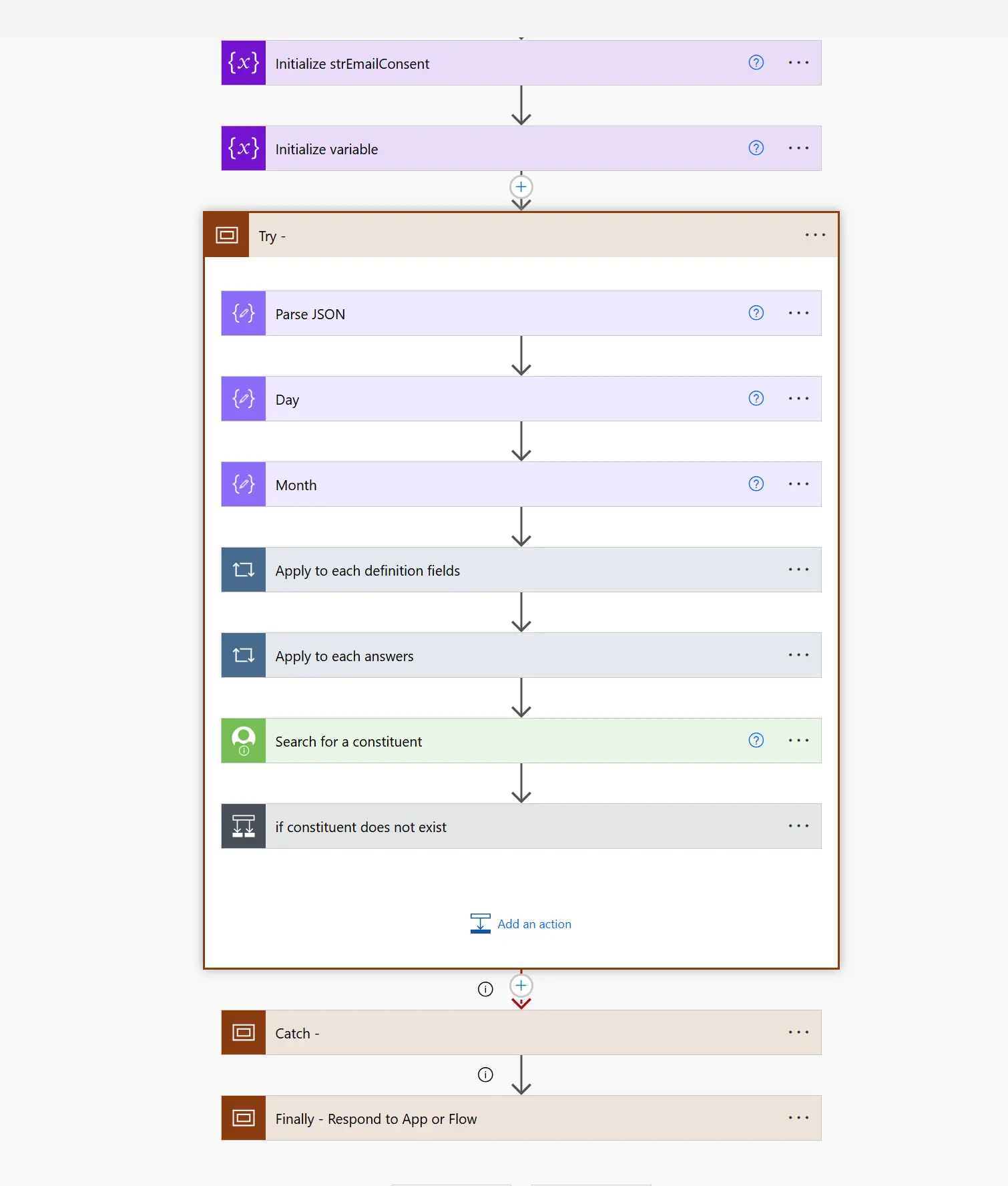
Managed RPA exists because supervision is a discipline, not a task. We design and build your automations on Power Automate cloud and desktop flows, then take responsibility for them in production: monitoring with meaningful alerting, error handling that knows a safe retry from a real failure, maintenance as the systems around them change, and reporting that shows the hours the estate is actually saving.

It starts with discovery, because the biggest waste in RPA is automating the wrong process beautifully. We map candidate processes, score them on volume, stability and complexity, and model the return per process before anything gets built. Well-chosen automations typically remove 40–80% of the manual effort in a process. Badly chosen ones mostly remove goodwill.

The proof sits in the case studies below. The Ocean Conservation Trust automated the flow of subscriber data into their CRM and removed the manual re-entry entirely, and Seras Energy cut manual processing by 30% with automation built around their materials operation.

Governance is built in rather than bolted on: audit trails, access controls, an automation Centre of Excellence and quarterly reviews that decide what to automate next. You stay audit-ready, and the estate grows deliberately instead of organically.


Common Challenges We Solve

01

Manual Processes Consuming Valuable Time

Staff spending hours on repetitive, rule-based tasks like data entry, report generation, and system updates that could be fully automated.

02

High Error Rates in Repetitive Workflows

Manual execution of recurring processes introduces human error, leading to costly rework, compliance risks, and unreliable outcomes.

03

Automation Built but Left Unmanaged

RPA bots deployed without ongoing monitoring and maintenance quickly degrade as underlying systems change, leading to failed runs and lost ROI.

04

No Internal RPA Expertise to Scale

Lack of in-house Power Automate or RPA specialists means automation efforts stall after initial deployment, with no roadmap for expansion.

05

Compliance and Audit Trail Gaps

Automated processes running without proper governance, logging, or oversight create audit risks and make it difficult to demonstrate compliance.

Our Managed RPA Approach

  1. We analyse your existing processes and design Power Automate and RPA solutions that eliminate manual effort and drive consistent, accurate results.

    • Process discovery and automation feasibility assessment
    • Power Automate desktop and cloud flow development
    • Integration with Microsoft 365, Dynamics, and line-of-business systems
    • End-to-end testing and user acceptance validation
  2. We take ownership of your automation estate, proactively monitoring, maintaining, and optimising every flow and bot to ensure continuous performance.

    • Proactive monitoring with automated alerting on failures
    • Regular maintenance and updates as business systems evolve
    • Performance reporting and utilisation dashboards
    • Incident management with defined SLAs and rapid resolution
  3. We establish clear governance frameworks and continuously identify new automation opportunities to maximise the value of your RPA investment.

    • Automation Centre of Excellence (CoE) setup and enablement
    • Audit trails, access controls, and compliance documentation
    • Quarterly automation reviews and roadmap planning
    • Identification of new automation candidates across the business

Why Managed RPA

Automation without the overhead

Building automation is the easy part. Keeping it running, scaling it responsibly, and continuously improving it requires dedicated expertise. Our managed service removes that burden so your team can focus on outcomes, not maintenance.

Predictable Monthly Costs

Replace unpredictable project spend with a fixed monthly model. No surprise invoices, just transparent, value-driven automation management.

Faster Time to Automation

With a dedicated team that already understands your environment, new automation initiatives start and deliver faster than any in-house or ad-hoc approach.

Zero Degradation Risk

System changes break bots. Our proactive monitoring catches issues before they impact your business, ensuring your automation runs reliably every day.

Built-in Governance

Every bot we manage comes with full audit trails, access controls, and compliance documentation, so you're always audit-ready.

Continuous Expansion

We proactively identify new automation candidates each quarter, growing your automation ROI without growing your workload.

Microsoft Power Platform Experts

Certified Power Automate and Power Platform specialists at your disposal, backed by Synapx's Microsoft Solutions Partner status.

How It Works

From discovery to continuous delivery

01

Process Discovery

We map your existing workflows, identify high-value automation candidates, and build a prioritised roadmap.

02

Bot Development

Our certified engineers design and build Power Automate flows and RPA bots tailored to your systems and processes.

03

Deploy & Govern

We deploy bots with full governance controls, audit logging, and monitoring dashboards in place from day one.

04

Manage & Improve

Ongoing proactive management, quarterly reviews, and continuous identification of new automation opportunities.

Automation Models

Managed RPA, in-house team, or one-off project?

Automation programmes fail in predictable ways, and most of them trace back to choosing the wrong operating model rather than the wrong technology. Here is the honest comparison.

Managed RPA, in-house team, or one-off project?
Criteria Synapx Managed RPA In-house automation team One-off automation project
What you get A supervised, growing automation estate with SLAsFull control, and a new specialist function to staffWorking bots on handover day
Up-front cost Low: discovery, then a monthly subscriptionHigh: recruitment, tooling and trainingMedium: a project fee
When bots break We catch it, fix it and engineer out the patternYour team firefights alongside the day jobA new statement of work
Scaling New candidates identified and delivered every quarterLimited by team bandwidthEach expansion is a new project
Governance CoE, audit trails and documentation includedDepends on internal disciplineOften skipped to hit the deadline
Best when You want the outcomes without building the functionAutomation is core to your operating model at real scaleYou need one bot and accept the maintenance risk

One-off projects are how most automation journeys start, and how many of them stall. If automation matters enough to do twice, it matters enough to supervise. We will help you make that case with numbers from your own processes, starting with the discovery assessment.

Client Voices

From our automation clients

"A robust digital ecosystem that empowers our teams."

"Synapx automated complex, manual processes, modernised legacy systems, and delivered scalable Power Platform solutions that streamline workflows and provide real-time insights. Their standout achievement was integrating SiteOps for accurate, real-time management of materials and compliance across multiple sites. Thanks to their future-proof architecture, we now have a robust digital ecosystem that empowers our teams."

Seras Energy Ltd

Head of Projects & Service Delivery, Seras Energy Ltd

"Delivered exactly what we needed, and incredibly responsive throughout."

"Their team delivered exactly what we needed, taking time to understand the purpose and specific requirements. By linking our Typeform online surveys with our Raisers Edge database, using Power Automate, they have enabled us to automate our incoming data processes. From our initial enquiry, scoping and delivery, we found them incredibly responsive and very good to communicate with."

The Ocean Conservation Trust

Head of Fundraising, The Ocean Conservation Trust

Managed RPA FAQ

Common questions about scope, returns, licensing and what happens when a bot misbehaves.

What does Managed RPA include?

The full lifecycle: process discovery and ROI modelling, bot design and build on Power Automate cloud and desktop flows, deployment, then ongoing monitoring, error handling, maintenance and improvement. You get the outcomes of an automation estate without having to build the team that runs one.

What happens when a bot fails overnight?

Automation estates need supervision, because the systems they touch keep changing. Our monitoring picks up failures, retries what is safely retryable, and queues what needs human attention with full context. Recurring failure patterns get engineered out, not just restarted.

Which processes automate best?

High-volume, rules-based work with structured inputs: invoice processing, data entry between systems, report distribution, onboarding checklists, reconciliations. During discovery we score candidate processes on volume, stability and complexity, and we will tell you which ones are not worth automating.

What returns should we expect from RPA?

Automating well-chosen processes typically removes 40–80% of the manual effort involved. Discovery includes ROI modelling per process, so the business case is explicit before we build anything.

Do we need separate RPA software licences?

Power Automate is usually the right engine because it already sits inside your Microsoft licensing, and we optimise the plan mix as part of the service. Where you have existing investments in other RPA tools, we will be honest about whether to keep or migrate them.

Can our team take over the bots later?

Yes. Everything is built in solutions with proper ALM, documented, and owned by you. Some clients graduate to running their own estate with our training; most keep the managed service, because supervision is the part they never wanted to staff.

Can you take over bots another partner built?

Yes. We assess the existing estate, document and stabilise the fragile parts, then bring the bots under our monitoring and governance. It is one of the most common ways clients arrive.

How quickly can the first automation go live?

Discovery typically takes two to three weeks, and a first well-chosen automation usually reaches production within four to eight weeks of starting. We deliberately pick an early win with visible value, because nothing builds appetite for automation like a process that stops being anyone's job. The pace after that is set by the roadmap we agree together each quarter.

Our Clients

Trusted by

Glassmoon
Lanware
Micheldever Tyre Services
Midwich
Mount Anvil
Nuevo Partners
Pro Global
Seras Energy
Skanska
Ocean Conservation Trust
WA Comms
Glassmoon
Lanware
Micheldever Tyre Services
Midwich
Mount Anvil
Nuevo Partners
Pro Global
Seras Energy
Skanska
Ocean Conservation Trust
WA Comms

Who owns your bots?

Get an RPA estate review: we'll map what's running, what's failing silently and what each automation is actually saving, then show you what supervised automation would change.

Get an RPA estate review