
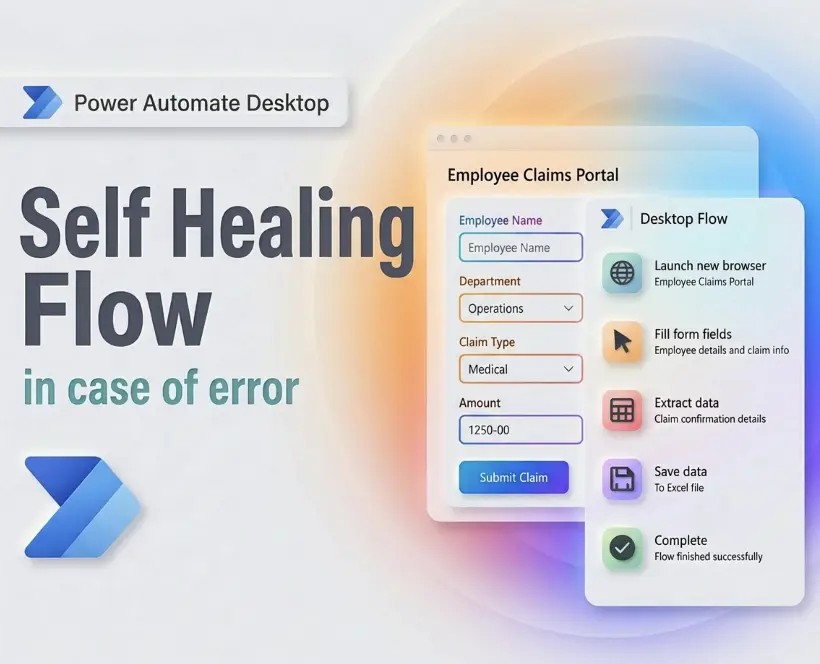
Enterprise automation is at a turning point. For years, organisations have invested in workflow automation and robotic process automation to reduce manual effort, speed up approvals, and streamline repetitive tasks. Yet many programmes have hit the same wall: flows break when applications change, exceptions rise as inputs become less structured, and maintenance starts consuming the time that should be spent scaling value. Instead of driving transformation, automation can become another layer of operational overhead.
That is why the latest Power Automate capabilities matter commercially, not just technically. Microsoft’s 2026 release wave 1 highlights AI agent authoring, optimisation, and self-healing capabilities for desktop flows, signalling a shift from static automation to more intelligent, resilient execution. A key aspect of this release is the deep integration of Microsoft Copilot, which enables automation to be created, modified, and optimised using natural language.
Why this matters now?
For enterprise leaders, the real question is not whether these features are innovative. It is about whether they can help the business automate more profitably, reduce dependence on manual fixes, and scale automation without increasing complexity.
This shift is commercially significant because it gives organisations a way to improve process resilience, reduce support overhead, and strengthen the return on automation investment.
What is AI agent authoring in Power Automate?
AI agent authoring in Power Automate moves automation design away from rigid, step-by-step configuration and towards goal-based execution. In a traditional flow, a maker defines every action, branch, and dependency manually. In an agentic model, the user defines the intended outcome, guardrails, and constraints, and the system helps determine the best way to complete the task.
While these capabilities introduce more adaptive automation patterns, they complement rather than replace traditional deterministic flows, which remain essential for structured and compliance-driven processes.
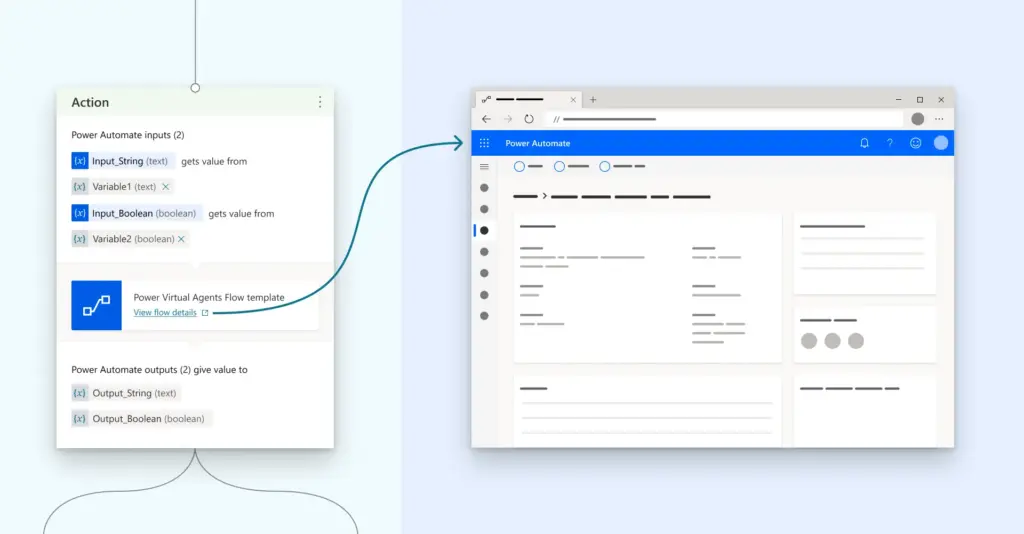
That matters commercially because many enterprise processes do not follow a single predictable route. Customer onboarding, invoice reconciliation, procurement processing, service case management, and document handling all involve exceptions, variations, and changing inputs. When automation can handle more of that complexity intelligently, businesses can reduce process friction, shorten cycle times, and lower the cost of manual intervention.
What are self-healing flows?
Self-healing in Power Automate for desktop is designed to make UI and browser automation more resilient. When a supported action fails with an Element not found error because an expected element is missing or has changed, self-healing can attempt to identify the most likely correct element at runtime and continue the flow instead of failing immediately.
Microsoft Learn describes self-healing as an AI-powered preview capability in Power Automate for desktop that helps flows recover from UI and browser automation failures caused by missing or changed UI elements. It is currently available for eligible organisation premium accounts in supported regions, applies to attended and unattended console and cloud runs, and does not affect designer runs.
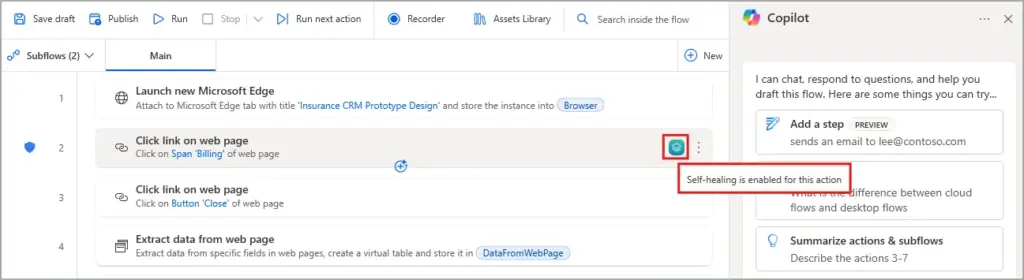
This directly addresses one of the most expensive barriers to scaling RPA: fragility. Traditional automations often depend on static selectors, specific screen layouts, or fixed interfaces. Even small application changes can trigger failures, rework, service disruption, and additional support costs. Self-healing helps reduce those disruptions by improving runtime recovery and lowering the effort required from internal automation teams.
How Power Automate is changing enterprise automation?
Taken together, AI agent authoring and self-healing flows point to a broader shift in enterprise automation strategy. Power Automate is evolving beyond task automation towards more intelligent process execution, with workflows becoming more adaptive and better suited to environments where change is constant.
Copilot-driven capabilities further assist makers in building, debugging, and enhancing flows more efficiently.
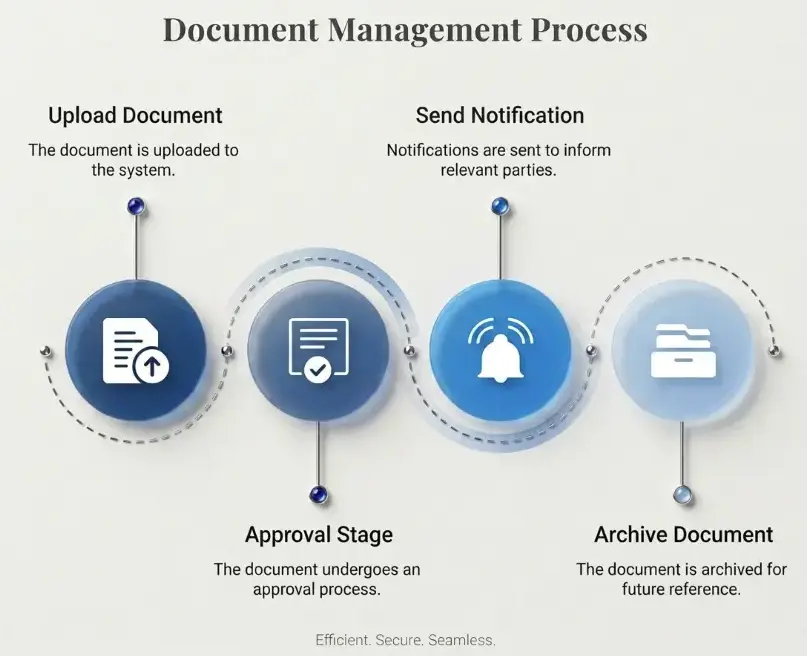
For organisations scaling automation across finance, operations, HR, customer service, and IT, this is a meaningful change. Many businesses already have dozens or hundreds of automations in place, but maintenance often grows faster than value. These new capabilities point to a more sustainable model, where automation can better handle exceptions, variable inputs, and changing interfaces while delivering stronger continuity and lower support overhead.
Beyond AI agent authoring and self-healing flows, Power Automate in Release Wave 1 introduces additional capabilities that strengthen enterprise automation, including improved desktop flow features such as better scheduling, logging, and visualisation, enhanced maker experiences in the cloud flow designer, deeper integration with Copilot Studio, and continued advancements in process analysis and monitoring capabilities.
High-value enterprise use cases
Invoice processing: Traditional flows can capture, route, and validate data, but they often struggle when document formats differ or source systems change. A more adaptive automation approach can improve throughput, reduce manual handling, and support more reliable finance operations.
Customer service operations: In many service environments, employees move between portals, systems, and applications that evolve frequently. Self-healing desktop flows can improve automation reliability in these environments, while AI agent authoring can support workflows with more decision points and cross-system complexity.
Legacy application automation: Many enterprises still depend on older systems that lack modern APIs and require desktop automation. These are precisely the environments where brittle automations create hidden support costs. A more resilient Power Automate approach can extend the useful life of these automations and improve the economics of modernisation.
What enterprises should consider before adopting these capabilities?
These capabilities are promising, but they are not a substitute for a strong automation strategy. AI-driven automation still requires good process design, clear governance, appropriate human oversight, and a realistic view of where agentic behaviour adds value.
Organisations should start by identifying where automation currently breaks most often, where maintenance effort is highest, and where process variation is limiting scale. They should also assess governance requirements around security, auditability, exception handling, and licensing.
How to turn Power Automate innovation into business value?
The strongest automation strategies combine platform capability with commercial prioritisation. That means reviewing the current automation estate, identifying fragile or high-maintenance processes, selecting use cases where resilience will improve ROI, and designing governance that supports scale rather than slowing it down.
For many organisations, the opportunity is not simply to adopt new features. It is to redesign automation around resilience, adaptability, and measurable business outcomes.
How Synapx can help ?
Synapx helps organisations turn Power Automate from a tactical automation tool into a commercially aligned transformation capability. We work with teams to identify the highest-value automation opportunities, uncover where fragile flows and manual workarounds are slowing the business down, and design resilient automation that is built to scale.
From automation assessments and use case prioritisation to workflow design, governance, and optimisation, we help organisations connect platform capability to measurable business outcomes, including improved reliability, lower support overhead, and stronger automation ROI.
If your organisation is exploring how Power Automate AI agent authoring and self-healing flows could reduce maintenance effort, improve continuity, and create faster commercial returns, Synapx can help you identify where to start and how to scale with confidence.
Final thoughts
If you are looking to move beyond fragile automations, now is the time to assess where intelligent, resilient automation can deliver the greatest business impact.