
Most organisations are sitting on valuable data, but few know how effectively they use it.
The difference between organisations that extract real value from data and those that struggle often comes down to two interrelated concepts: data assessment and data maturity.
Understanding both is critical for leaders making decisions about AI investments, analytics platforms, or digital transformation. Without clarity on where your organisation sits today and what it will take to move forward, even well-funded initiatives risk stalling at the pilot stage.
This guide explains what data assessment and data maturity are, why they matter, how they work together, and what steps leaders should take to improve both.
What Is Data Assessment?
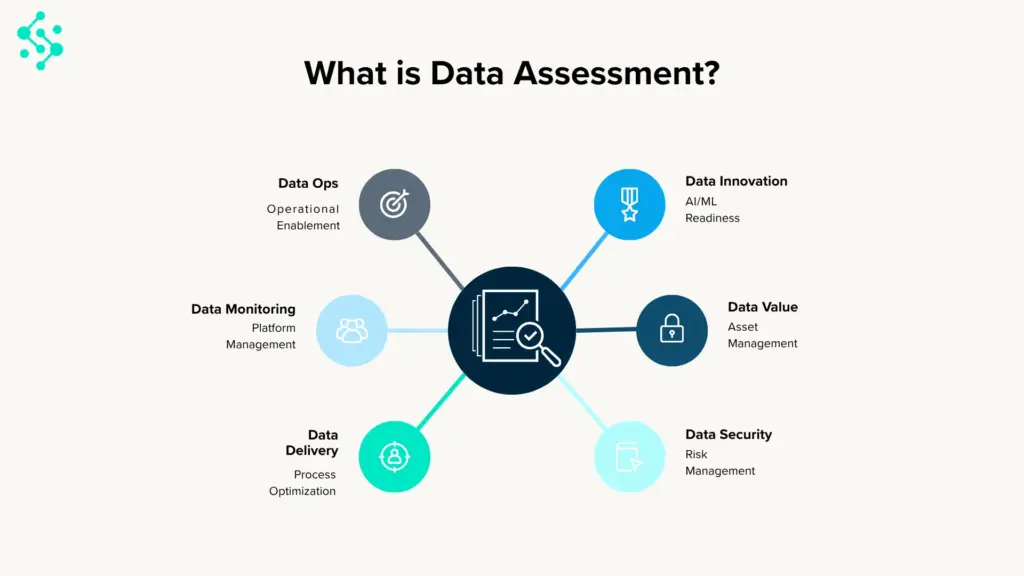
A data assessment is a structured, point-in-time evaluation of an organisation’s current data landscape, capabilities, and readiness.
It answers essential questions:
- What data do we have, and where does it live?
- How is it governed, managed, and used today?
- Where are the gaps, risks, or quality issues?
- What capabilities exist to support analytics, AI, and decision-making?
- Are we ready to invest in advanced analytics or AI?
For business leaders, a data assessment provides clarity: Is our data environment ready to support the decisions, analytics, and AI initiatives we need to drive the business forward?
A data assessment is typically a rapid, focused diagnostic (3–4 weeks) rather than an exhaustive, multi-month audit. The goal is to identify priority gaps and create a clear action plan, not to produce a lengthy technical report.
What Is Data Maturity?
Data maturity refers to an organisation’s ongoing ability to effectively manage, govern, and use data to support business objectives and drive measurable outcomes.
It reflects:
- How well data flows across the organisation
- How consistently data is trusted and used
- How quickly insights translate into decisions
- How scalable data capabilities are
Data maturity is not about having the latest technology. It is about having the right foundations, processes, governance, and culture to turn data into action consistently over time.
High data maturity means:
- Data is trusted, accessible, and used consistently across functions
- Analytics and AI initiatives scale beyond pilots
- Governance, quality, and security are embedded in operations
- Leaders make decisions based on real-time, reliable insights
Low data maturity means:
- Data lives in silos; manual work is required to reconcile reports
- Trust in data is inconsistent; decisions are delayed
- AI and analytics pilots fail to scale
- Governance gaps create risk
How Data Assessment and Data Maturity Work Together?
Data assessment is the diagnostic that reveals current maturity.
Data maturity is the capability you build over time.
Think of data assessment as a health check. It tells you where you are today, your strengths, weaknesses, and readiness. Data maturity is the measure of your organisation’s long-term fitness: how well you manage data, how consistently you improve, and how effectively you scale capabilities.
The relationship:
- A data assessment identifies current maturity gaps and prioritises where to focus effort.
- Data maturity improves as you address those gaps through targeted investments in governance, platforms, skills, and culture.
- Regular assessments (annually or after major initiatives) track progress and ensure maturity continues to improve.
Without assessment, organisations invest blindly, unsure whether they are solving the right problems. Without a maturity framework, assessment findings lack context and prioritisation.
Together, they provide the clarity leaders need to make confident, outcome-driven decisions.
What Is a Data Maturity Model?
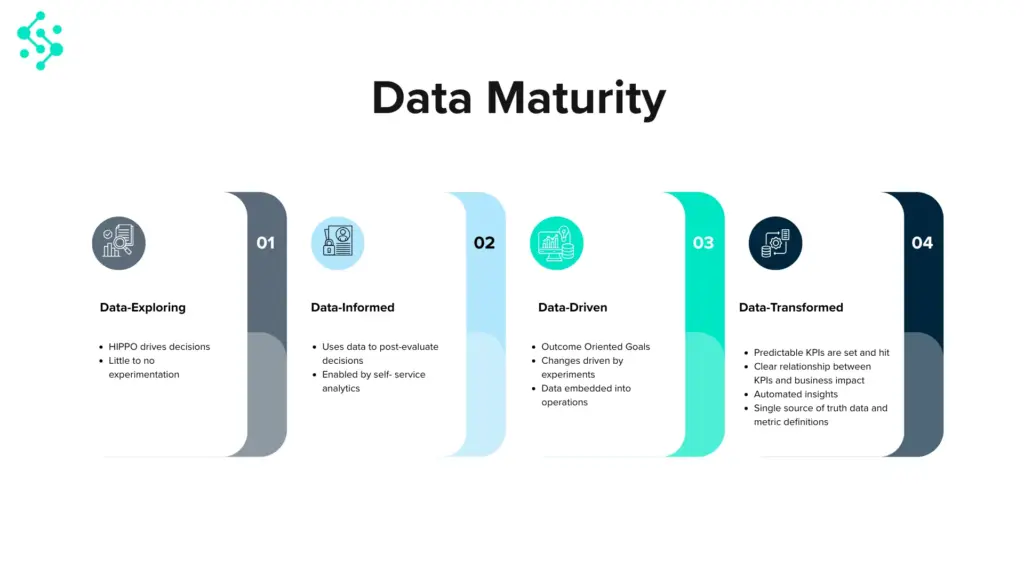
A data maturity model is a framework that defines stages or levels of data capability, from basic data collection to advanced, AI-driven autonomous operations.
Maturity models help organisations:
- Benchmark current capabilities against best practices
- Identify gaps that limit analytics and AI effectiveness
- Prioritise investments based on business outcomes
- Track progress over time as capabilities improve
Most data maturity models are structured around five progressive stages, each representing a higher level of data sophistication and business value.
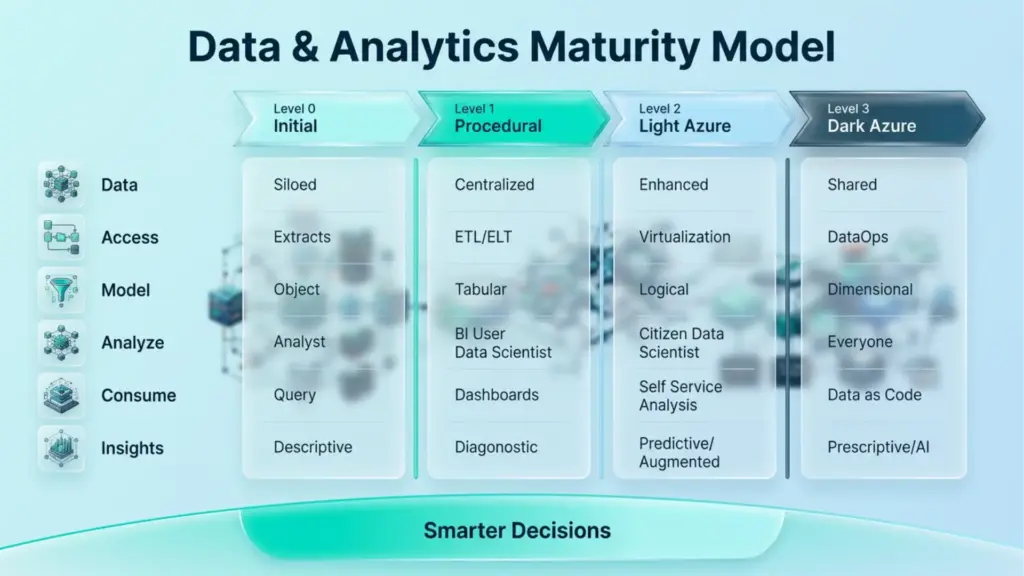
The Five Stages of Data Maturity (and Where Assessment Fits)
The following framework synthesises common industry models (Gartner, DAMA, and consultancy-led approaches) into a simple, executive-friendly structure with a clear assessment focus at each stage.
| Stage | Characteristics | Assessment Focus | Business Impact |
| 1. Initial (Ad Hoc) | Data is siloed in departmental systems. Reporting is manual, inconsistent, and periodic. Limited or no governance. | Identify data sources, silos, and critical gaps. Assess readiness for foundational investments. | Slow response to business changes; limited operational visibility. |
| 2. Developing (Repeatable) | Basic data standards exist. Some governance frameworks are documented. Analytics tools available, but adoption is uneven. | Evaluate governance maturity, data quality issues, and barriers to wider analytics adoption. | Improved visibility, but inconsistency limits confidence and scalability. |
| 3. Defined (Managed) | Unified data platform established. Governance is enforced. Data quality monitored. Self-service analytics are available to business users. | Assess platform scalability, governance effectiveness, and readiness for predictive analytics and AI. | Faster, more confident decision-making across functions. Reduced manual effort. |
| 4. Advanced (Optimised) | Predictive analytics and machine learning models in production. AI use cases scaled. Real-time data enables proactive decisions. | Evaluate AI maturity, model governance, and opportunities to scale AI across business units. | Operational excellence; competitive advantage through insight and automation. |
| 5. Leading (Autonomous) | AI-driven systems make operational decisions with minimal human intervention. Continuous improvement loops refine models autonomously. | Assess autonomous decision-making systems, ethics frameworks, and continuous improvement mechanisms. | Market leadership; continuous adaptation, innovation, and agility. |
For most organisations, the goal is to move from Stage 1–2 (Initial/Developing) to Stage 3 (Defined/Managed), creating the foundation required to scale analytics and AI effectively. A data assessment helps clarify what is required to make that transition.
Key Dimensions of Data Assessment and Maturity
When conducting a data assessment or evaluating maturity, organisations should examine capabilities across six core dimensions.
1. Data Strategy & Leadership
What to assess:
- Is there a clear data strategy aligned with business objectives?
- Does executive leadership actively sponsor and champion data initiatives?
- Is there accountability for data outcomes (e.g., Chief Data Officer or equivalent)?
Why it matters: Without executive sponsorship and strategic alignment, data initiatives remain tactical and fail to scale.
2. Data Governance & Quality
What to assess:
- Are data definitions consistent across the organisation?
- Is data quality actively monitored, measured, and improved?
- Are roles and responsibilities for data ownership clearly defined?
Why it matters: Poor governance and quality undermine trust in analytics and create compliance risks.
3. Data Foundation & Architecture
What to assess:
- Is data unified on a single platform or fragmented across silos?
- Can data be accessed in real time or near-real time?
- Is architecture scalable to support AI and advanced analytics?
Why it matters: Fragmented data architectures slow analytics, increase costs, and prevent AI from scaling.
4. Analytics & AI Readiness
What to assess:
- Are analytics capabilities available to business users (not just IT)?
- Are predictive models and AI use cases in production?
- Is there a clear roadmap from descriptive to predictive analytics?
Why it matters: Organisations with low analytics readiness cannot extract value from AI investments.
5. Operating Model & Skills
What to assess:
- Is there a clear operating model for data (centralised, federated, or hybrid)?
- Do teams have the skills required to manage, analyse, and use data effectively?
- Is data literacy embedded across the organisation?
Why it matters: Even the best platforms fail without the right skills and operating model.
6. Culture & Adoption
What to assess:
- Do leaders and teams trust data and use it to make decisions?
- Is there a culture of experimentation, learning, and continuous improvement?
- Are data-driven insights embedded in daily workflows?
Why it matters: Culture is often the biggest barrier to scaling data capabilities. Technology alone does not change behaviour.
Why Data Assessment and Maturity Matter for Business Leaders?
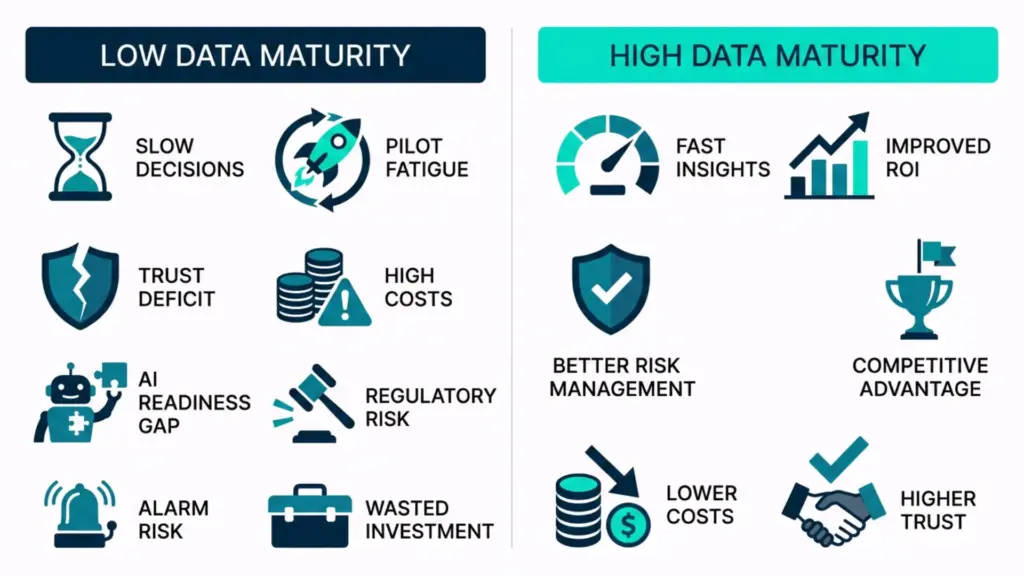
Understanding data assessment and maturity is not an academic exercise. It directly impacts business outcomes.
The Cost of Low Data Maturity
Organisations with low data maturity, often revealed through a data assessment, face predictable challenges:
- Slow decision-making: Data lives in silos; manual extraction and reconciliation delay insights
- Pilot fatigue: AI and analytics projects succeed in isolation but fail to scale
- Trust deficit: Inconsistent definitions and poor quality undermine confidence in reports
- High analytics costs: Fragmented tools and duplicate systems increase licensing and maintenance expenses
- AI readiness gap: Machine learning models require unified, high-quality data, low-maturity organisations lack this foundation
- Regulatory risk: Poor governance creates compliance and audit vulnerabilities
- Wasted investment: Tools are purchased but underused due to lack of adoption or integration
The Value of High Data Maturity
Organisations that invest in data assessment and improve maturity see tangible benefits:
- Faster time to insight: Decisions are made in hours or minutes, not days or weeks
- Improved ROI on analytics and AI: Investments scale beyond pilots and deliver measurable value
- Better risk management: Strong governance reduces compliance, security, and operational risk
- Competitive advantage: Real-time insights enable faster response to market changes
- Lower costs: Unified platforms eliminate duplicate systems and reduce manual effort
- Higher trust: Consistent data quality and definitions build confidence across leadership
How to Conduct a Data Assessment?
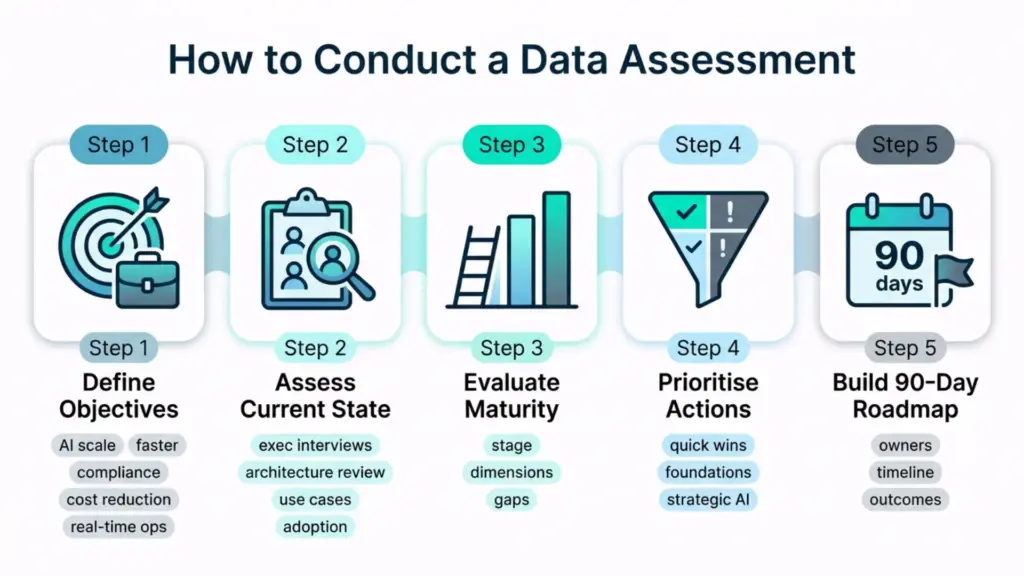
A data assessment should be rapid, focused, and outcome-driven, not exhaustive or technical.
Step 1: Define Business Objectives
Key question: What business outcomes require better data capabilities?
Examples:
- Scaling AI and predictive analytics
- Reducing time to insight for executive decisions
- Improving regulatory compliance and auditability
- Reducing cost of analytics and reporting
- Enabling real-time operational decision-making
Step 2: Assess Current State
Evaluate current capabilities across the six core dimensions through:
- Executive interviews (CEO, CFO, CIO, CDO, COO, business leaders)
- Review of existing data architecture, governance frameworks, and tools
- Identification of current analytics use cases and pain points
- Assessment of skills, culture, and adoption
Key questions to ask during a data assessment:
- What decisions require better data visibility today?
- Where do leaders lack confidence in data?
- What analytics or AI initiatives have stalled, and why?
- What regulatory or compliance risks exist?
- How is data currently governed and managed?
- What data silos exist, and where do manual reconciliation efforts occur?
Step 3: Evaluate Maturity
Map current capabilities to a data maturity model. Identify:
- Current maturity stage (Initial, Developing, Defined, Advanced, Leading)
- Maturity level by dimension (Strategy, Governance, Foundation, Analytics, Operating Model, Culture)
- Gaps between current state and target state
Step 4: Prioritise Actions
Compare current state to target state based on business objectives. Identify:
- Quick wins: High-impact, low-effort improvements (30–60 days)
- Foundation investments: Data platform, governance, and operating model (6–12 months)
- Strategic initiatives: Advanced analytics and AI (dependent on foundation)
Step 5: Create a 90-Day Roadmap
Translate assessment findings into a practical action plan with clear ownership, timelines, and expected outcomes.
For executives, the value is clarity: What to start, what to stop, what to scale.
Common Pitfalls in Data Assessments
Pitfall 1: Over-Engineering the Assessment
Risk: Lengthy, detailed assessments that take months and lose executive attention.
Solution: Keep assessments rapid (3–4 weeks), focused on business outcomes, and actionable.
Pitfall 2: Focusing on Tools Instead of Maturity and Outcomes
Risk: Assessments become vendor pitches for technology stacks.
Solution: Lead with maturity and business outcomes. Technology recommendations should emerge from identified gaps, not drive them.
Pitfall 3: Using Generic Frameworks Without Context
Risk: Assessments feel academic or disconnected from real business challenges.
Solution: Tailor assessment and maturity evaluation to industry context and specific business objectives.
Pitfall 4: No Clear Next Steps
Risk: Assessments produce insights, but no action, creating “analysis paralysis.”
Solution: Always end with a prioritised, actionable 90-day roadmap.
How Synapx Approaches Data Assessment and Maturity?
At Synapx, data assessment is not about lengthy reports or abstract maturity scoring.
It is about giving business leaders the clarity required to make confident decisions about where to invest, what to prioritise, and how to move from reactive reporting to proactive, insight-driven operations.
Our approach is rapid, pragmatic, and outcome-focused:
- 3–4 week data assessment delivering current state evaluation, maturity scoring, gap analysis, and 90-day roadmap
- Business outcome-led, not technology-led (though we bring deep expertise in the Microsoft ecosystem, including Fabric, Copilot, and Power Platform)
- Prioritised action focused on quick wins, foundation work, and strategic initiatives
- Clear investment guidance to help CFOs and boards justify data platform, analytics, and AI investments
- Maturity tracking over time, with follow-up assessments to measure progress and refine strategy
We start with clarity because clarity creates confidence, and confidence accelerates action.
If your organisation is evaluating data platform investments, AI initiatives, or analytics modernisation, a data assessment can provide the foundation to move forward with confidence and improve data maturity systematically.
Book a Data Assessment with Synapx to identify priority gaps, evaluate maturity across key dimensions, and receive a practical 90-day plan aligned to your business objectives.