

Not long ago, most organisations were still in AI discovery mode- testing ideas, running pilots, and trying to work out where the technology could make a difference. That phase was important. But it is no longer where the conversation is.
Today, AI is steadily finding its way into everyday operations. The bigger question for leadership teams is no longer whether to experiment with AI, but how to turn those experiments into something that creates real, measurable business value.
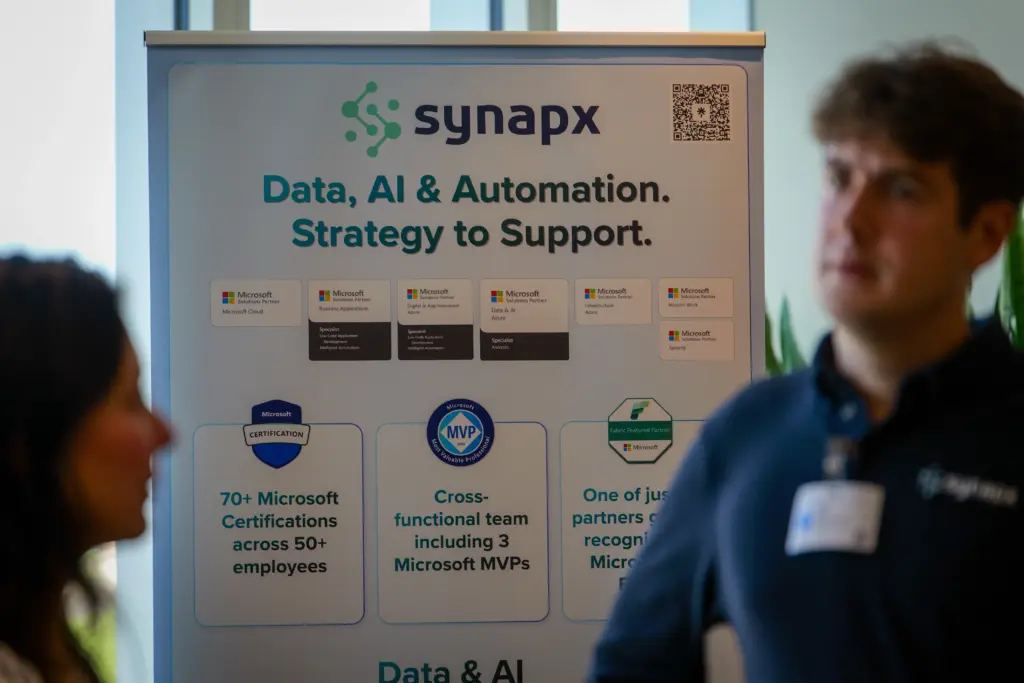
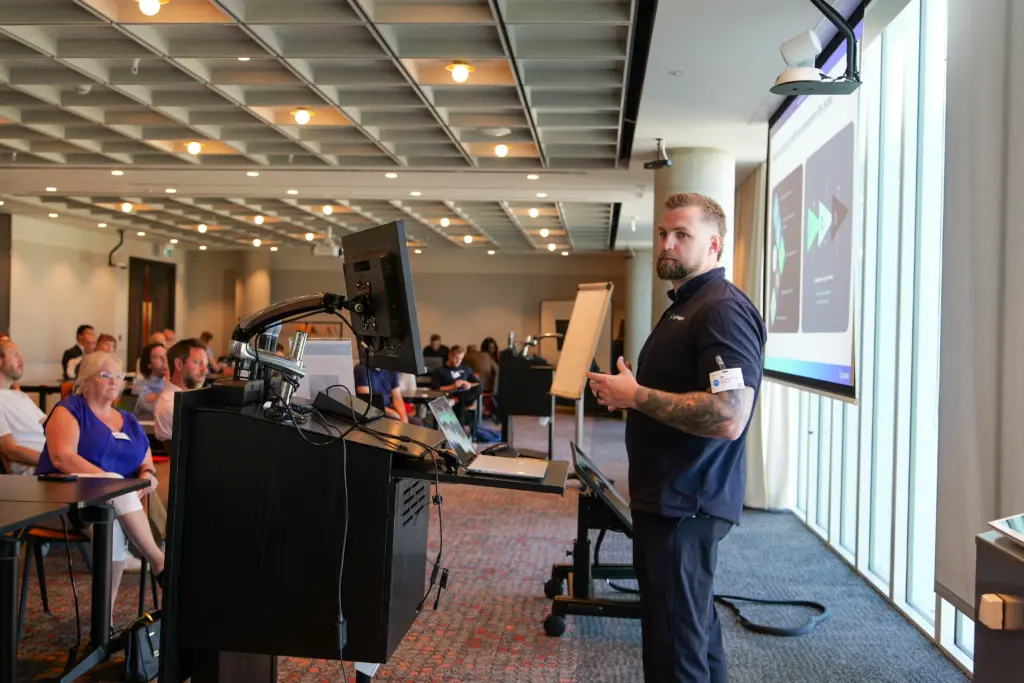
That was exactly the focus of Synapx’s executive event with Microsoft: helping leaders think beyond experimentation and start building an approach to AI that can deliver measurable impact in 2026 and beyond.
Why So Many AI Pilots Fail to Scale Across the Enterprise?
Many organisations have made real progress with AI, but plenty are still stuck between early experimentation and enterprise-scale impact. There are pilot projects, proofs of concept, and a few isolated wins, but often no clear path to measurable AI ROI, sustainable adoption, or long-term business value.
Despite the activity, many organisations remain stuck between experimentation and impact. They have invested time and resources into AI initiatives, but struggle to translate those efforts into measurable ROI, sustained adoption, or enterprise-wide value. The result is a growing sense of frustration. AI is being used, but not yet fully realised.
In many cases, the issue is not the technology itself. It is the challenge of connecting AI initiatives to real business priorities, clear ownership, and day-to-day workflows in a way that actually moves the needle.

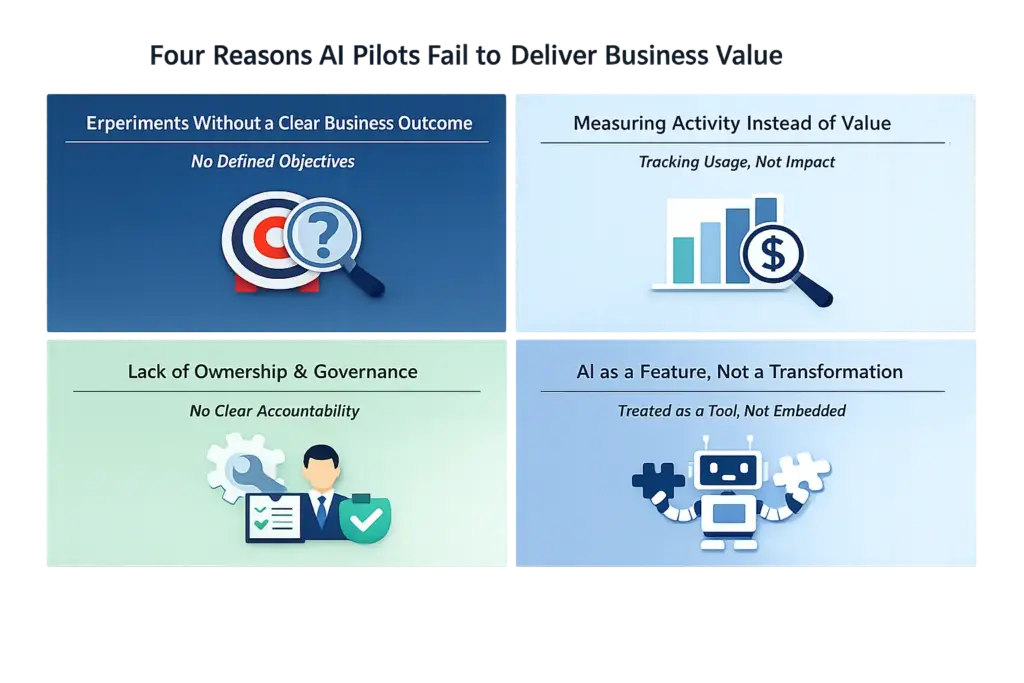
Four Reasons AI Pilots Struggle to Deliver Measurable Business Value
1. The pilot was built to impress, not to integrate
Pilots are often optimised for the demo moment. They show what AI can do in ideal conditions – clean data, a willing test group, a narrow use case. What they rarely show is how AI will behave inside messy real-world workflows, with inconsistent data, legacy systems, and people who have fifteen other priorities.
When scaling begins, these unresolved questions hit all at once. The result is months of re-engineering that could have been avoided.
2. Success was measured in usage, not outcomes
“Five hundred employees activated” sounds like progress. It isn’t – at least not on its own.
The organisations that struggle to demonstrate AI ROI are almost always the ones that tracked adoption instead of impact. Real measurement means asking harder questions before you launch: What does this workflow look like today? What should it look like in six months? What’s the cost of not changing?
Without baseline metrics and agreed success criteria, there’s no way to prove the value of what you’ve built and no way to make the case for the next investment.
3. Lack of Ownership and Governance
AI initiatives often live in an awkward space between IT, operations, and whatever team the use case belongs to. Everyone contributes. Nobody is accountable.
This isn’t a governance technicality. It’s the reason change stalls. When AI touches a workflow that spans multiple teams, someone needs clear authority to make decisions, resolve conflicts, and drive adoption. Without that person and without executive backing, even well-designed solutions quietly fade.
4. AI Treated as a Feature, not a Transformation
The biggest missed opportunity in most AI deployments is the assumption that AI should fit around existing processes rather than improve them.
Dropping a generative AI tool into a broken workflow doesn’t fix the workflow. It just makes the broken parts faster. The organisations creating the most value are the ones asking a different question: if we were designing this process from scratch, with AI as a first principle, what would it look like?
What High-Performing Organisations Do to Scale AI Successfully?
The gap between organisations that are realising significant AI value and those still stuck in pilot purgatory isn’t about budget or technical capability. It comes down to a handful of deliberate choices.
They start with fewer, better bets. Rather than spreading AI investments across twenty use cases, they identify three or four where the business case is clear, the data is accessible, and the workflow change is achievable. They go deep rather than wide.
They define success in business terms before they write a line of code. Time saved per transaction. Cost per query. Error rates before and after. These metrics aren’t retrospective – they’re agreed upfront, embedded into the project brief, and reviewed at every milestone.
They treat governance as an enabler, not a constraint. Clear ownership, defined escalation paths, and sensible guardrails don’t slow AI down. They prevent the kind of organisational gridlock that kills promising projects six months in.
And critically, they close the loop. Every deployment generates data – about how people are using the system, where it’s falling short, and where there’s untapped value. High-performing organisations build the feedback mechanisms to capture that signal and use it to improve continuously.
What Agentic AI Means for Business Workflows?
Up to this point, most enterprise AI has been assistive. A tool that helps a human work faster. A model that surfaces information more efficiently. Valuable, but ultimately bounded.
That’s changing.
Agentic AI systems – ones capable of planning multi-step tasks, coordinating across tools and data sources, and executing actions with a degree of autonomy are moving from research labs into enterprise environments. The early use cases are already live: automated contract review that triggers approval workflows, customer service agents that resolve issues end-to-end without human intervention, procurement tools that identify anomalies, initiate supplier queries, and escalate only when genuinely needed.
The potential is significant. So is the risk of getting it wrong.
Agentic AI amplifies both good process design and bad. An autonomous system built on a flawed workflow doesn’t just perpetuate the problem – it scales it, faster, across more transactions, with less visibility. This is why the organisations that will deploy agentic AI most successfully are the ones already doing the unglamorous work: fixing their data, clarifying their processes, building governance, and measuring outcomes.
The fundamentals haven’t changed. The consequences of ignoring them have.
From AI Projects to AI-Driven Organisations
Ultimately, the goal is not just to run better pilots. It is to build organisations where AI becomes part of how work gets done – embedded in operations, tied to clear outcomes, and improved over time as confidence and maturity grow.
It also requires a shift in mindset. AI must be treated not as a series of projects, but as a capability that evolves, one that influences how decisions are made, how processes run, and how value is created across the organisation.


Conclusion: The End of the Experimentation Phase
The era of AI experimentation is not over, but it is no longer enough on its own. For leaders looking ahead to 2026, the real opportunity lies in moving beyond isolated use cases and building AI strategies that are practical, governed, and capable of delivering measurable business value.
If you’re a leader thinking about AI strategy for the next 12 to 18 months, the most useful question isn’t “where should we pilot AI next?” It’s “why haven’t our existing pilots scaled – and what does that tell us about what we need to fix?”
The answer to that question is usually more instructive than any new use case. And addressing it honestly is what separates organisations that are genuinely building AI capability from those that are just accumulating proofs of concept.
The experimentation phase served its purpose. The organisations that will lead in 2026 are the ones that have decided it’s over.