
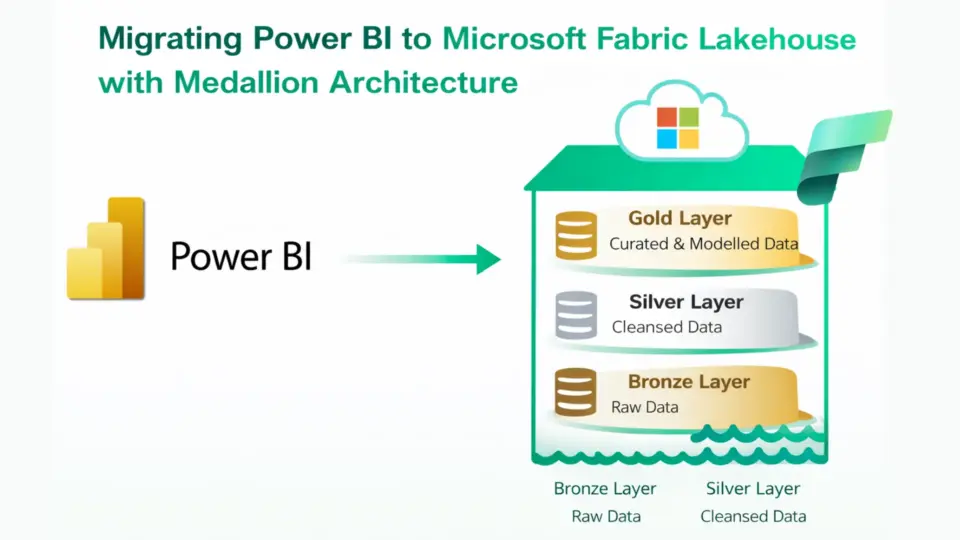
Migrating to a Microsoft Fabric Lakehouse can seem overwhelming at first, and honestly, it often is without the right structure in place.
You’re not just moving data; you’re rethinking how your entire data ecosystem works.
But here’s the good news: when done right, this migration becomes a major advantage. It allows you to unify your data, simplify pipelines, and unlock faster, more reliable analytics across your organization.
This is where medallion architecture comes in.
Instead of dealing with messy, unstructured data flows, medallion architecture provides a clear, layered approach to organizing your data from raw ingestion to refined, business-ready insights.
In this blog, we’ll explore how this approach works within Microsoft Fabric and why it’s becoming the go-to strategy for building scalable, high-performance data platforms.
Why Use Medallion Architecture in Fabric?
At its core, medallion architecture is all about bringing order to complexity.
Rather than handling data in a single layer, it organizes it into structured stages, making your entire pipeline easier to manage, scale, and optimize.
Let’s break down why this matters in a real-world setup.
1. It Improves Data Quality at Every Stage
One of the biggest challenges in any data system is dealing with inconsistent or messy data.
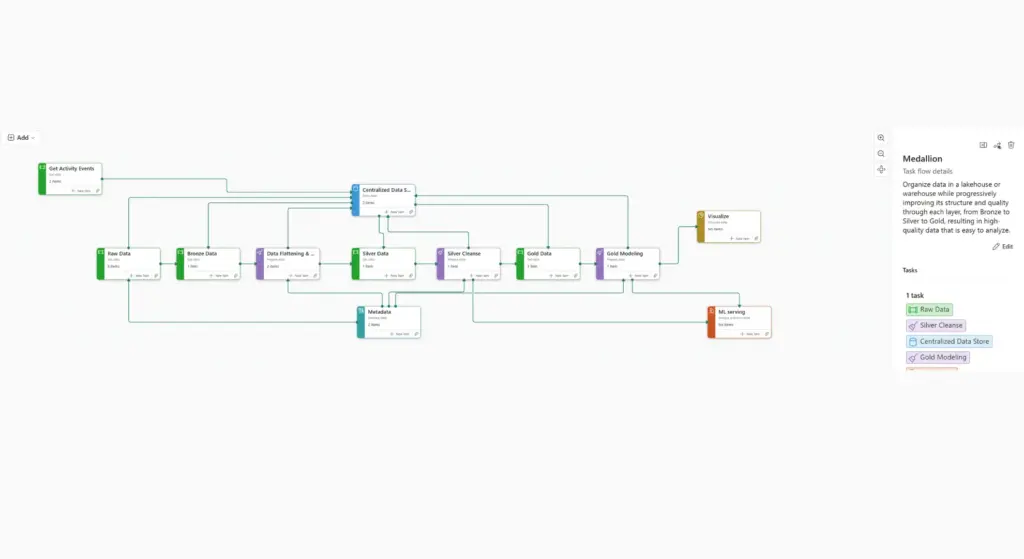
Medallion architecture solves this by introducing layers (commonly Bronze, Silver, and Gold), where data is:
- Collected in its raw form
- Cleaned and validated
- Refined for analytics
This step-by-step refinement ensures that by the time data reaches reporting tools, it’s accurate, consistent, and reliable.
The result: better insights and fewer errors in decision-making
2. It Creates Scalable and Manageable Pipelines
As your data grows, complexity grows with it.
Without structure, pipelines become:
- Hard to maintain
- Difficult to debug
- Expensive to scale
Medallion architecture keeps everything organized by separating concerns at each layer. This makes it much easier to:
- Add new data sources
- Modify transformations
- Scale processing without breaking existing workflows
In simple terms: your system grows without becoming chaotic
3. It Enables Faster and More Efficient Analytics
When data is properly structured, everything downstream becomes faster.
Instead of querying raw, unoptimized datasets, your analytics tools work with refined, ready-to-use data. This leads to:
- Faster query performance
- Reduced load times
- Better user experience for reports and dashboards
Your teams spend less time waiting and more time making decisions.
4. It Simplifies Data Governance and Control
Another major benefit is visibility.
With clear layers in place, it becomes easier to:
- Track where data comes from
- Understand how it’s transformed
- Control access at different stages
This is especially important for organizations dealing with compliance and security requirements.
5. It Aligns Perfectly with Microsoft Fabric’s Design
Microsoft Fabric is built to support modern data architectures and medallion architecture fits naturally into it.
By combining:
- Lakehouse storage
- Data engineering tools
- Analytics capabilities
Fabric makes it easier to implement this layered approach without needing multiple disconnected systems
The Construction Data Explosion and Why Traditional BI Can’t Keep Up
Traditional Power BI implementations work adequately for individual construction projects or departments. But as your construction business grows, managing concurrent sites, larger projects, complex supply chains, and stringent regulatory requirements, the limitations become apparent. Construction data sits fragmented across estimating systems, project management platforms, ERP software, and site reporting tools. Business intelligence reports take hours to refresh. Different construction teams see conflicting metrics for identical KPIs. Your IT team spends more time troubleshooting data connections than enabling construction analytics insights.
Mount Anvil, one of London’s leading residential developers, confronted exactly this construction data challenge. As their property development portfolio expanded and construction projects grew in complexity, their existing construction business intelligence infrastructure couldn’t keep pace. What had functioned for simpler reporting requirements now constrained their ability to leverage construction data analytics for strategic decision-making at the speed modern property development demands.
Why Microsoft Fabric Is Transforming Construction Data Analytics
Microsoft Fabric represents a paradigm shift in how construction firms architect their construction data analytics foundation. By migrating Power BI to a Fabric Lakehouse built on Medallion Architecture, forward-thinking construction companies achieve something transformational, simplified construction BI infrastructure delivering exponentially greater analytical capability.
Microsoft Fabric delivers a unified, end-to-end data and analytics platform that helps construction organisations simplify complex data environments while accelerating time to insight across projects, finance, and operations.
Many construction firms operate with fragmented data spread across ERP systems, project controls tools, estimating platforms, and spreadsheets. Microsoft Fabric consolidates these disconnected systems into a single, governed analytics foundation, providing a trusted source of truth for project, cost, and performance data.
By seamlessly connecting to platforms such as Dynamics 365, SAP, Procore, Primavera P6, Snowflake, Databricks, AWS, GCP, and Azure, construction organisations utilise insights from existing data without costly migrations or disruption to live projects.
With Copilot and built-in AI, project teams, commercial managers, and executives move faster from raw data to decisions. Natural language queries, automated insights, and self-service analytics reduce reliance on specialist reporting teams while improving visibility across project portfolios.
Fabric creates a shared analytics foundation that connects project controls, commercial, finance, operations, and leadership teams, eliminating silos across systems and roles. As a result, construction firms reduce reporting overhead, improve project visibility, and shift from reactive reporting to proactive, insight-driven decision-making.
Understanding Medallion Architecture for Construction Data Analytics
Before exploring construction BI migration strategy, construction decision-makers must understand why Medallion Architecture has become the gold standard for construction data platforms within Microsoft Fabric.
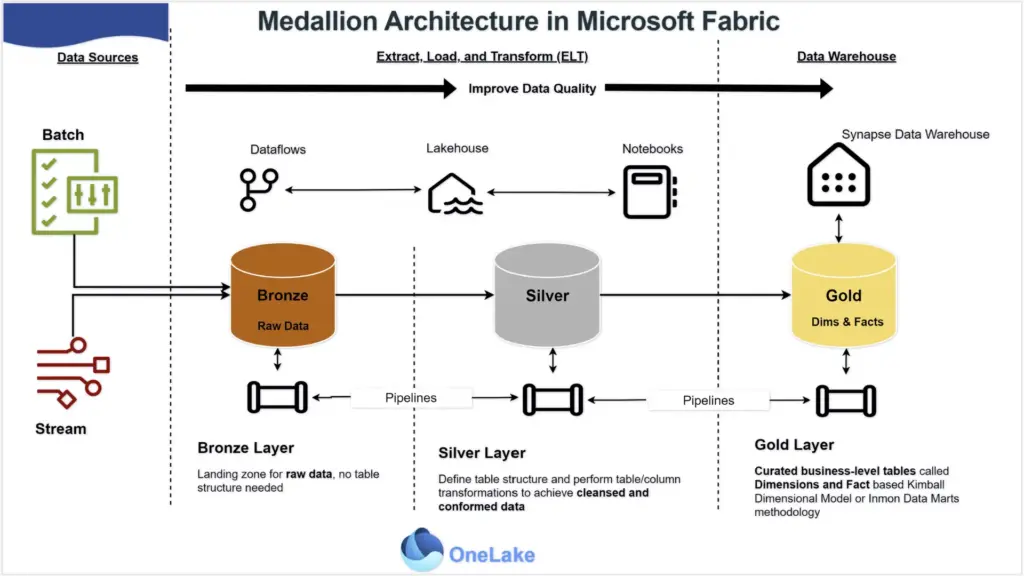
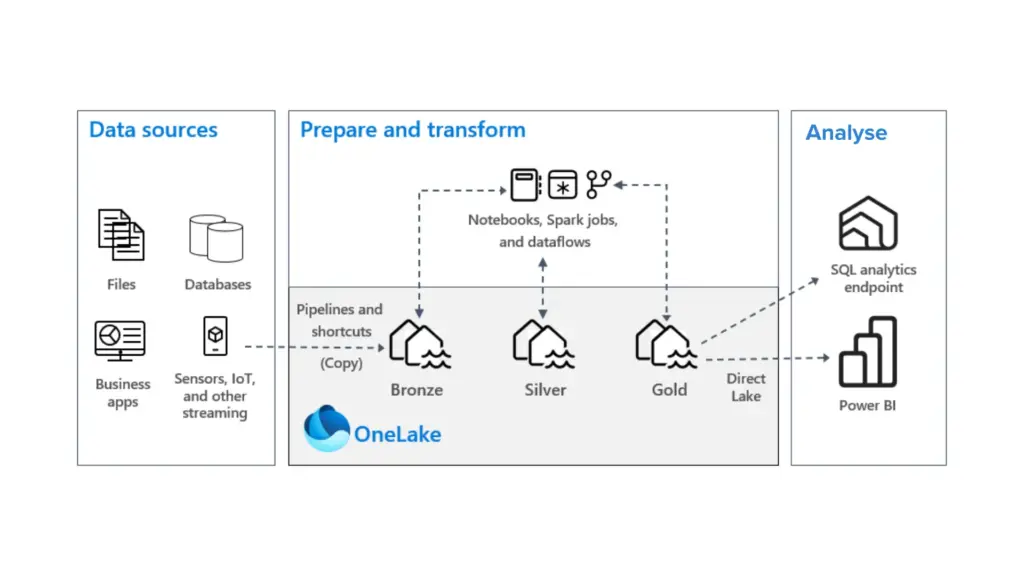
The Medallion approach organises construction data in three progressive layers optimised for construction business intelligence:
Bronze Layer: Centralised Raw Construction Data Repository
Every construction data source, your construction ERP system, project management software, site reporting apps, subcontractor portals, IoT sensors, and equipment telematics feeds into Bronze tables exactly as generated. No transformations, no filtering, just complete, immutable historical construction data records.
For construction operations, this construction data governance approach is invaluable. Construction project lifecycles span months or years. Disputes arise. Claims get filed. Contract variations occur. Having an auditable record of every construction data point from every source provides the defensible position construction companies need when questions emerge years after practical completion.
Silver Layer: Standardised Construction Data for Reliable BI
Raw construction data is inherently messy. Material codes vary between suppliers. Labour hours get recorded differently across construction sites. Cost codes lack consistency between construction projects. Subcontractor data formats are inconsistent.
The Silver layer in construction data analytics cleanses, standardises, and validates this construction information. Business rules apply. Data types align. Duplicates get eliminated. The result is your authoritative construction dataset – validated, queryable, and ready for construction business intelligence analysis across the entire construction operation.
For multi-site construction operations, this construction data standardization is transformational. Finally, you can compare construction performance across projects with confidence, knowing you’re measuring like-for-like construction metrics.
Gold Layer: High‑Performance Analytics for Construction KPIs
Gold tables contain aggregated, optimised construction datasets tailored for specific construction business intelligence needs. Construction project performance dashboards, cost variance analysis, resource utilisation reports, safety metrics, cash flow forecasting, labour productivity analytics, each get a purpose-built construction data structure that delivers instant query performance.
Your construction project managers get real-time site data. Your commercial team sees up-to-the-minute cost positions. Your construction executives access consolidated portfolio views. All pulling from the same governed, trusted construction data foundation.
Why Power BI Alone Struggles in Large Construction Environments
Most construction firms running Power BI today face predictable construction business intelligence challenges that Medallion Architecture systematically solves:
Fragmented Construction Data Sources
Your construction estimating system doesn’t integrate with your project management platform. Site reporting happens in spreadsheets. Financial construction data lives in your ERP. Subcontractor information exists in yet another system. Equipment data comes from telematics providers. Power BI tries connecting to all these construction data sources, creating a web of dependencies that breaks constantly. Your team spends more time fixing construction data connections than analysing construction projects.
Inconsistent KPIs Across Projects
When individual construction sites or divisions build their own Power BI reports, critical construction KPIs mean different things across the construction business. “Labour productivity” gets calculated three different ways. “Construction project completion percentage” varies by who’s reporting. “Cost per square metre” uses inconsistent denominators. Executive construction meetings become exercises in reconciling construction data rather than making construction business decisions.
Construction BI Performance Problems
As construction projects accumulate and construction data volumes grow, Power BI reports slow dramatically. DirectQuery becomes painfully sluggish with construction databases. Import mode hits size limits with historical construction data. Users stop using sophisticated construction analytics and fall back on simpler, less insightful reports or worse, revert to construction spreadsheets.
Construction Data Governance Gaps
Construction is heavily regulated. Health and safety data must be auditable. Financial reporting faces strict construction accounting requirements. Building regulations demand comprehensive records. Trying to track construction data lineage across multiple Power BI workspaces, databases, and systems becomes nearly impossible. When auditors or construction regulators ask questions, you scramble to trace construction information back to source.
Lack of Scalability for Multi‑Site Construction
You win a major framework contract or expand into new construction regions. Suddenly you need to onboard construction data from dozens of new subcontractors and integrate additional construction sites. Your existing Power BI environment wasn’t designed to scale construction data this way. Every new construction data source becomes a custom integration project.
Mount Anvil experienced these exact construction data pressures as their development portfolio grew. Simple reporting had evolved into complex construction analytics demands spanning multiple concurrent construction projects, each with unique financial structures, regulatory requirements, and stakeholder reporting needs. Their Power BI environment, built for simpler construction operations, couldn’t keep up with construction business intelligence requirements. Microsoft Fabric with Medallion Architecture eliminates these construction data constraints by design, not through workarounds.
Real-World Construction Data Transformation: Mount Anvil’s Journey
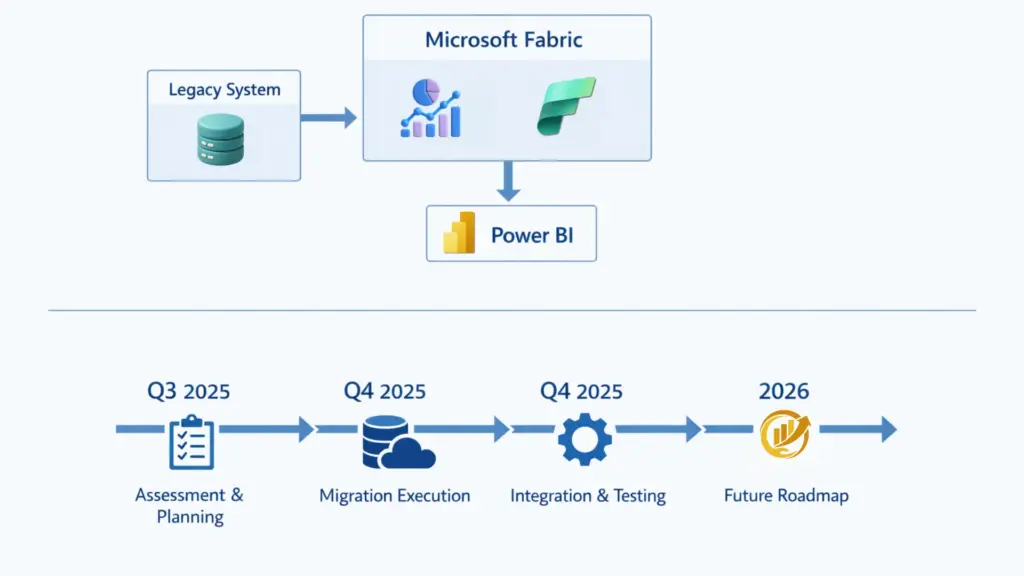
When Mount Anvil partnered with Synapx to migrate their Power BI infrastructure to Microsoft Fabric, it represented more than construction technology upgrade. It was a fundamental reimagining of how construction data would support their continued growth and operational excellence in the competitive London residential construction market.
The Challenge: When Construction Success Creates Data Complexity
Mount Anvil’s construction data challenge will resonate with any growing construction business. Success in their core mission, delivering exceptional residential developments and thriving communities, had created construction data complexity that their construction analytics infrastructure couldn’t handle.
Their construction reporting requirements had evolved significantly:
Multi-Project Construction Data Management
Managing construction data across concurrent development sites, each with unique timelines, budget structures, planning conditions, and stakeholder requirements. Consolidating construction performance data across projects meant wrestling with inconsistent formats and manual reconciliation.
Complex Construction Financial Modelling
Residential property development involves intricate construction financial planning, land acquisition costs, phased construction expenditure, revenue recognition across staged completions, forecasting across multi-year construction cycles, managing working capital. Existing construction systems struggled to provide the real-time construction financial visibility the construction business needed.
Construction Regulatory Compliance
The UK residential property sector faces stringent construction regulations, building safety requirements, planning obligations, environmental standards, and financial reporting requirements. Their construction data infrastructure needed to support comprehensive audit trails and regulatory reporting without creating operational burden.
Construction BI Performance Constraints
As construction data volumes grew, Power BI refresh times extended from minutes to hours. Reports that once loaded instantly became sluggish. Critical construction business insights arrived too late to influence construction decisions. Users grew frustrated with construction system performance.
Construction Analytics Scalability Concerns
With ambitious growth plans, Mount Anvil needed confidence their construction data infrastructure could scale with the construction business. Could the existing architecture support twice the number of construction projects? Three times the construction data volume? Increasingly sophisticated construction analytical requirements?
For a construction business built on quality and reputation, unreliable construction data insights represented strategic risk, not just operational inconvenience.
The Solution: Strategic Architecture for Construction Data Analytics
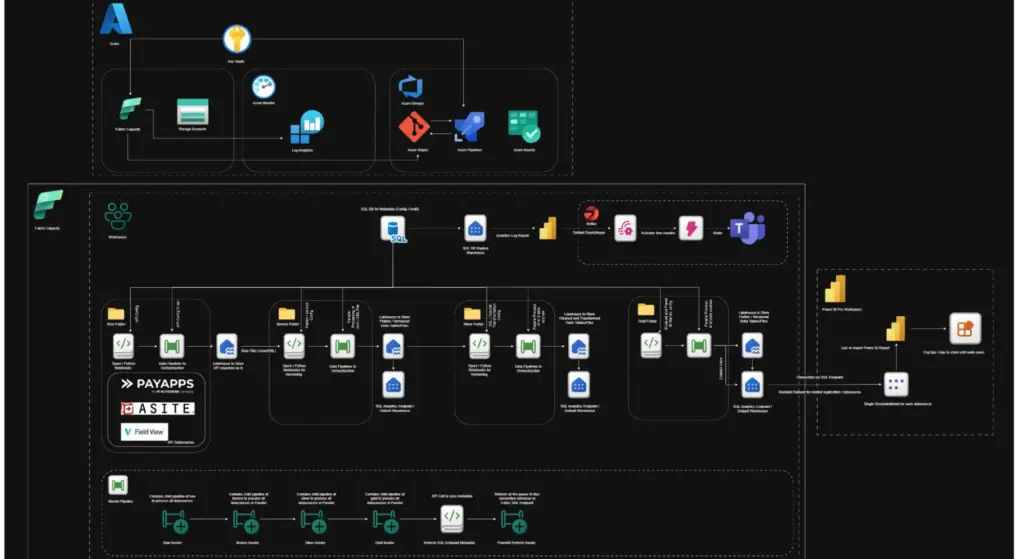
Synapx designed and implemented a comprehensive Microsoft Fabric Lakehouse leveraging Medallion Architecture principles, tailored specifically for Mount Anvil’s construction and property development operations:
Unified Construction Data Ingestion
The implementation began by connecting Mount Anvil’s diverse construction source systems. Project management platforms, financial systems, customer relationship databases, planning tools, site reporting applications, and construction data from every source flowed into standardised Bronze layer tables. This created an immutable, auditable record of all operational construction data, critical for an industry where construction project lifecycles span years and regulatory requirements demand complete construction data traceability.
Construction-Specific Business Logic
Synapx implemented standardized construction business rules specific to residential development operations. Construction data cleansing ensured consistency across projects and development phases. Transformation rules aligned disparate construction data models from different source systems. Validation logic caught construction data quality issues before they propagated to reporting. The result was a unified, validated construction dataset that could serve as the authoritative source for all downstream construction analytics.
Purpose-Built Construction Analytics Datasets
Construction project performance dashboards, financial reporting models, development appraisal tools, customer analytics, and operational metrics each received tailored construction data structures designed for optimal Power BI performance. These aggregated, optimised construction datasets delivered the responsiveness required for interactive executive decision-making while maintaining complete traceability back through the Medallion construction data layers.
Seamless Power BI Integration for Construction
Power BI reports connected directly to Gold layer semantic models, accessing clean, governed, high-performance construction data. The tight integration between Microsoft Fabric and Power BI eliminated the complexity of managing multiple connections and refresh schedules that had characterised the previous construction environment. Construction reports that previously took hours to refresh are now updated in minutes.
The Outcomes: From Construction Data Constraint to Capability
The construction data migration delivered measurable outcomes that reinforced Mount Anvil’s operational excellence:
Construction Technical Challenges, Solved
The sophisticated construction analytical requirements that had outgrown their previous systems now had an appropriate construction data architectural foundation. Complex construction requirements that previously needed workarounds or manual intervention became standard construction capabilities within the Medallion framework.
Construction BI Performance at Scale
Power BI reports that previously struggled with construction data volume now delivers responsive, interactive experiences. Construction decision-makers could explore project data, drill into cost variances, analyse development appraisals, and review operational metrics without the construction performance constraints that had limited previous analysis.
Construction Data Governance and Auditability
In the heavily regulated residential development sector, complete construction data lineage and audit trails aren’t optional. The Medallion Architecture provided transparency from construction source systems through every transformation to the final report, giving Mount Anvil confidence in both construction data accuracy and regulatory compliance. When questions arise, from internal stakeholders, auditors, or construction regulators, they can trace any number back to its source.
Foundation for Construction Growth
Critically, Mount Anvil now has a scalable, future-ready construction data foundation aligned to its long-term ambitions. The Fabric Lakehouse architecture that supports current construction complexity has the capacity to accommodate new construction projects, additional construction data sources, and the advanced construction analytics capabilities that their continued growth will demand.
Construction Operational Confidence
With a reliable, performant, governed construction analytics infrastructure in place, Mount Anvil’s teams could focus on what they do best, delivering exceptional homes and thriving communities. The construction infrastructure now supports the construction business rather than constraining it.
Strategic Takeaways for Construction Data Leaders
Mount Anvil’s construction data journey offers principles applicable across construction and property development:
Recognise Your Construction Data Inflection Point
There’s a moment in every construction business’s growth when yesterday’s adequate reporting becomes today’s construction data constraint. Perhaps you’ve expanded from regional to national construction operations. Maybe you’ve moved into larger, more complex construction projects. Or you’ve diversified into new construction sectors.
Recognising this construction data inflexion point early, before construction analytics infrastructure becomes a bottleneck to strategic initiatives, preserves competitive momentum. Waiting until the construction data problem is acute means making construction decisions with inadequate information at precisely the moment when construction insight matters most.
Why Modern Data Architecture Enables Business Growth
Sophisticated construction operations demand sophisticated construction data architecture. Managing multiple concurrent construction sites, integrating supply chain data, forecasting construction cash flow across projects, optimising resource allocation, ensuring construction safety compliance, and meeting regulatory requirements, these construction capabilities require a proper construction data foundation.
The Medallion Architecture approach within Microsoft Fabric provides the structural capability that growing construction businesses require as construction analytical needs evolve from simple to highly technical construction business intelligence.

What We’ve Learned From Delivering Microsoft Fabric for Construction Clients
As one of only 30 Microsoft Fabric Featured Partners globally, we’ve helped construction and infrastructure organisations modernise fragmented data platforms into a unified Fabric architecture aligned to real project and commercial use cases.
What consistently worked was adopting Lakehouse + Direct Lake patterns to integrate data from a wide range of construction systems, such as ERP, cost control, scheduling, and procurement, without disrupting existing delivery processes.
Early engagements highlighted common challenges, particularly around workspace design, semantic modeling, and performance expectations for large project datasets. These challenges were especially pronounced for teams transitioning from traditional on-prem reporting to SaaS analytics.
Copilot and self-service analytics accelerated adoption for project managers and commercial teams when paired with strong governance, role-based access, and clear ownership across project and portfolio reporting.
If we were to start again, we’d lead with a focused pilot aligned to priority project outcomes, standardise architectural patterns early, and scale Microsoft Fabric incrementally, delivering faster value while reducing implementation risk.
Navsheen Koul, Project Manager, Synapx shared:
“Because of the complexity of the data we were working with, there was a significant amount of business context and external vendor dependency that we needed to work through to ensure we were always focused on the right priorities. When you’re building a data foundation for a client like MA, spending enough time on data source discovery is absolutely critical, not just to ingest the data correctly, but also to reconcile it properly before moving into the Silver layer.
What I’d absolutely do again is the way we worked with the Mount Anvil team. Collaborating closely with client stakeholders and walking them through the architecture via knowledge transfers was a real highlight. Their curiosity and genuine interest in understanding the ‘how’ behind the solution made the engagement even more rewarding.
This was a complicated project with fragmented and inconsistent data sources, and in that context Microsoft Fabric was the obvious choice. Fabric gave us an integrated, scalable platform that simplified data ingestion, transformation, governance, and analytics in one place. It allowed the team to manage complexity without adding operational overhead, and for a project like this, we’d make the same choice again without hesitation.”
Why Industry Context Matters in BI Migration Projects
Construction and development have unique construction data challenges, long project cycles, complex financial structures, multi-party collaboration, stringent regulatory requirements, safety criticality, and supply chain complexity. Generic construction data platform implementations often miss these industry-specific construction nuances.
The right construction implementation partner understands both the Microsoft Fabric platform and construction’s specific context. They can translate construction business requirements into effective technical architecture because they understand how construction businesses actually operate.
Construction BI Migration is Strategic Investment
Modernising construction analytics infrastructure isn’t overhead to be minimised. It’s a strategic investment in organisational capability that directly impacts your ability to win construction work, deliver projects profitably, manage construction risk, and scale construction operations.
For Mount Anvil, dependable construction data infrastructure is fundamental to maintaining the operational excellence and reputation their construction brand represents. The same principle applies across construction; your construction data foundation either enables or constrains your construction business ambitions.
Planning Your Migration from Power BI to Microsoft Fabric
Every growing construction business faces a choice, continue managing the construction analytics infrastructure that struggles with increasing complexity, or architect for the sophisticated construction data requirements your business trajectory demands.
Microsoft Fabric with Medallion Architecture represents proven capability for construction firms, successful construction businesses whose growth has created construction data challenges that earlier-stage construction infrastructure cannot adequately address.
The question isn’t whether your construction data architecture needs modernisation. Your construction business complexity has already answered that. The question is whether your construction organisation will make this strategic construction investment proactively or reactively, before or after it becomes a constraint on construction growth and competitiveness.
Construction Use Case: Project, Cost, and Revenue Analytics on Fabric
Construction organisations use Microsoft Fabric to unify project, cost, contract, and revenue data across systems such as Dynamics 365 Finance, Business Central, project controls tools, and estimating platforms into a single analytics foundation.
With Fabric Link, customers enable near real-time integration between operational systems and Fabric, eliminating custom ETL pipelines and reducing data latency across project reporting.
What worked especially well for Mount Anvil was combining Lakehouse and Direct Lake to deliver trusted, high-performance dashboards for:
- Project cost vs budget
- Forecast final cost and margin
- Change management and variations
- Cash flow and earned value
all without duplicating operational data.
Project and commercial leaders gained faster visibility into project performance, margin risk, and cash flow, while business users explored insights through self-service analytics and Copilot.
By standardising project and financial analytics on Microsoft Fabric, Mount Anvil improved cross-team alignment, reduced manual reporting effort, and turned project data into actionable, decision-ready insights.
Partner with the Right Fabric & Construction Data Experts
Successful construction BI migration requires more than technical knowledge of Microsoft Fabric.
Synapx brings comprehensive expertise in Microsoft Fabric implementations for construction and development businesses, combining deep platform knowledge with construction-focused approach. From initial construction assessment through production deployment and beyond, the right construction partnership accelerates transformation while mitigating risk.
For construction businesses where reputation, delivery performance, and operational excellence are paramount, the construction analytics infrastructure supporting decision-making deserves the same commitment to quality that defines your construction project work.
Ready to Transform Your Construction Analytics?
Connect with Synapx to see how we can deliver the scalable, governed construction data analytics infrastructure your growing construction business demands.